
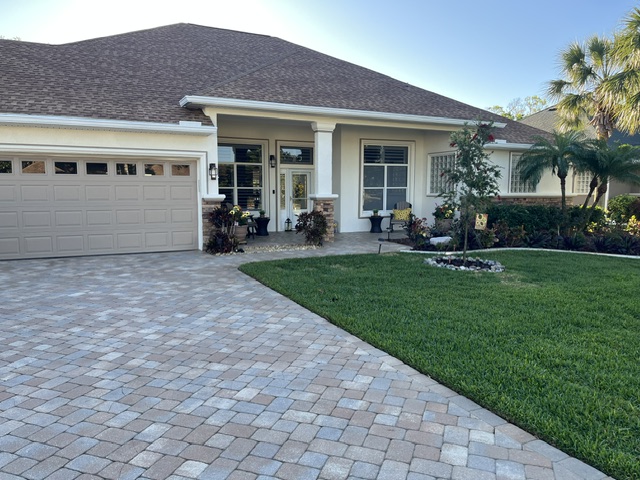
The "every 7–10 years" advice you'll read online is written for the rest of the country. In Florida — especially within a few miles of the coast — your exterior paint is fighting things most paint jobs never see: 90+ degree days, daily afternoon storms, salt-laden air, and 60–90% humidity year-round.
Here's what we actually see across hundreds of homes in New Smyrna Beach, Edgewater, Port Orange, South Daytona, Daytona Beach, and Ormond Beach.
Realistic Florida repaint timelines
Stucco (most homes here): 5–8 years for the body, 4–6 years for accent trim and front doors. The south- and west-facing walls always go first because of UV exposure. Our exterior painting services include a full stucco inspection before any coating is applied.
Wood siding or wood trim: 4–6 years. Wood moves with humidity, opens at the joints, and lets water in if the caulk and paint film aren't fresh.
Fiber-cement (Hardie, etc.): 8–12 years. The most stable surface for our climate. Failure usually shows at the field edges and around penetrations rather than across the panel face.
Metal trim and fascia: 6–10 years if it was primed properly. If it wasn't, you'll see rust bleeds at fastener heads and panel laps inside 3 years.
What "needs repaint" actually looks like
You don't always need to wait for full failure. Watch for:
- Chalking — when you wipe a finger across the wall and it comes away white. The pigment binders have broken down from UV.
- Hairline cracks in stucco that are starting to widen. Repaint plus elastomeric crack-fill stops them before water gets behind the coating.
- Color fading that's noticeably uneven — usually most pronounced on the south wall.
- Caulk pulling out at window frames, soffit transitions, or trim joints.
- Mildew bloom that returns within months of being washed off — paint film is no longer shedding moisture.
Any one of those means you've got 6–12 months before real damage starts. Two or three together and you're already overdue.
What gets it to last longer
Three things make the biggest difference:
- Prep, not paint. A premium product on a poorly prepped wall fails faster than a mid-grade product on a properly cleaned, primed, and caulked one. Pressure-washing, scraping loose material, spot-priming bare spots, and re-caulking joints buys you 2–4 extra years.
- The right product. For Florida exteriors we use 100% acrylic elastomerics on stucco (they bridge hairline cracks), and DTM (direct-to-metal) coatings on iron and aluminum. Generic exterior latex underperforms here.
- Two coats minimum. One coat sometimes looks fine on day one and fails at the 3-year mark instead of the 7-year mark. Spend the extra to do it twice.
What about the gulf-coast / interior comparison?
Coastal homes (within ~3 miles of the water) typically need repaint 1–2 years sooner than the same home 10 miles inland. Salt air is brutal on coatings and metal. If your home is in Bouchelle Island, Coronado, Ormond-by-the-Sea, or anywhere in Edgewater near the river, plan for the shorter end of the ranges above.
Touch-up between full repaints
A small annual touch-up — caulk maintenance, spot-painting front doors and shutters, re-coating the worst-hit south wall — can stretch a full repaint from 6 years to 9+. We do this on a lot of higher-end homes as a maintenance contract.
Bottom line
If your Florida home was last painted 6+ years ago (stucco) or 5+ years ago (wood), it's worth getting a walk-through inspection. Caught early, repaint is a finish job. Caught late, it becomes carpentry repair plus repaint, and the budget doubles.
Request a free exterior quote and we'll do the inspection at no charge — you'll get a written estimate and a real opinion on whether you can wait another season or not.